Fuel Optimizer

Optimize where and when drivers fuel

Fueling Performance guides every driver to the right fuel stop at the right time. Using your actual discounted prices, not guesswork.

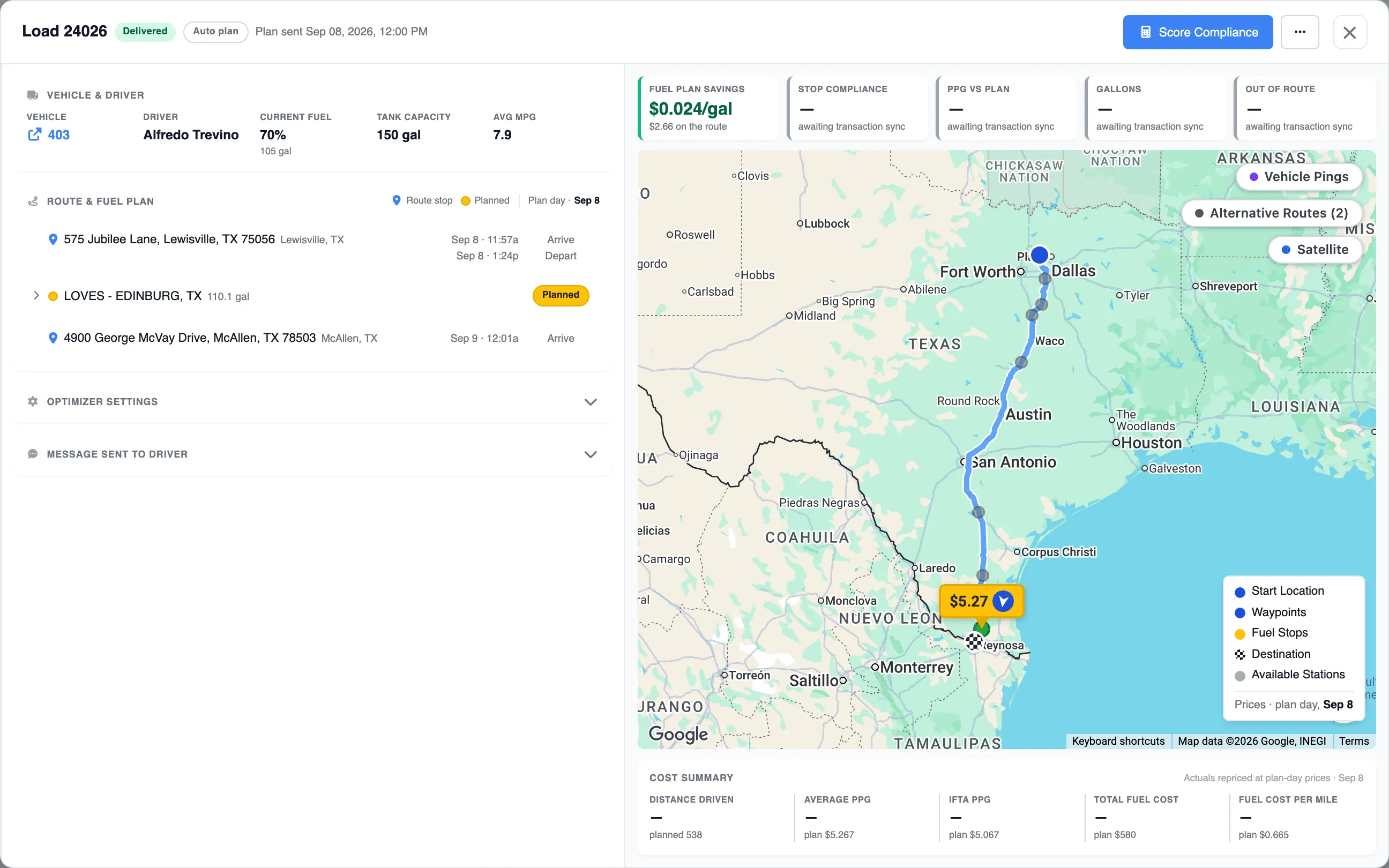
Fuel plan for Load 24026: vehicle 403 with driver Alfredo Trevino at 70% fuel, a 150 gallon tank and 7.9 MPG; the route from Lewisville to McAllen, Texas with a planned Love's Edinburg stop of 110.1 gallons, fuel plan savings of $0.024 per gallon, a route map with a $5.27 fuel-stop marker and the cost summary
A real fuel plan: vehicle 403 at 70% and 7.9 MPG, one planned Love's stop of 110.1 gallons at $5.27, scored against two alternative routes and sent to the driver.

The cost of convenience

Every Stop Is a Decision That Costs You Money

Drivers fuel where it's convenient, not where it's cheapest. Without route-aware guidance, fleets miss negotiated pricing, buy at the wrong time, and leave savings on the table on every single trip.

10¢/galour calculator's conservative optimizer default
$342,857a year for a 200-truck fleet buying 3,428,571 gallons
Run your own numbers
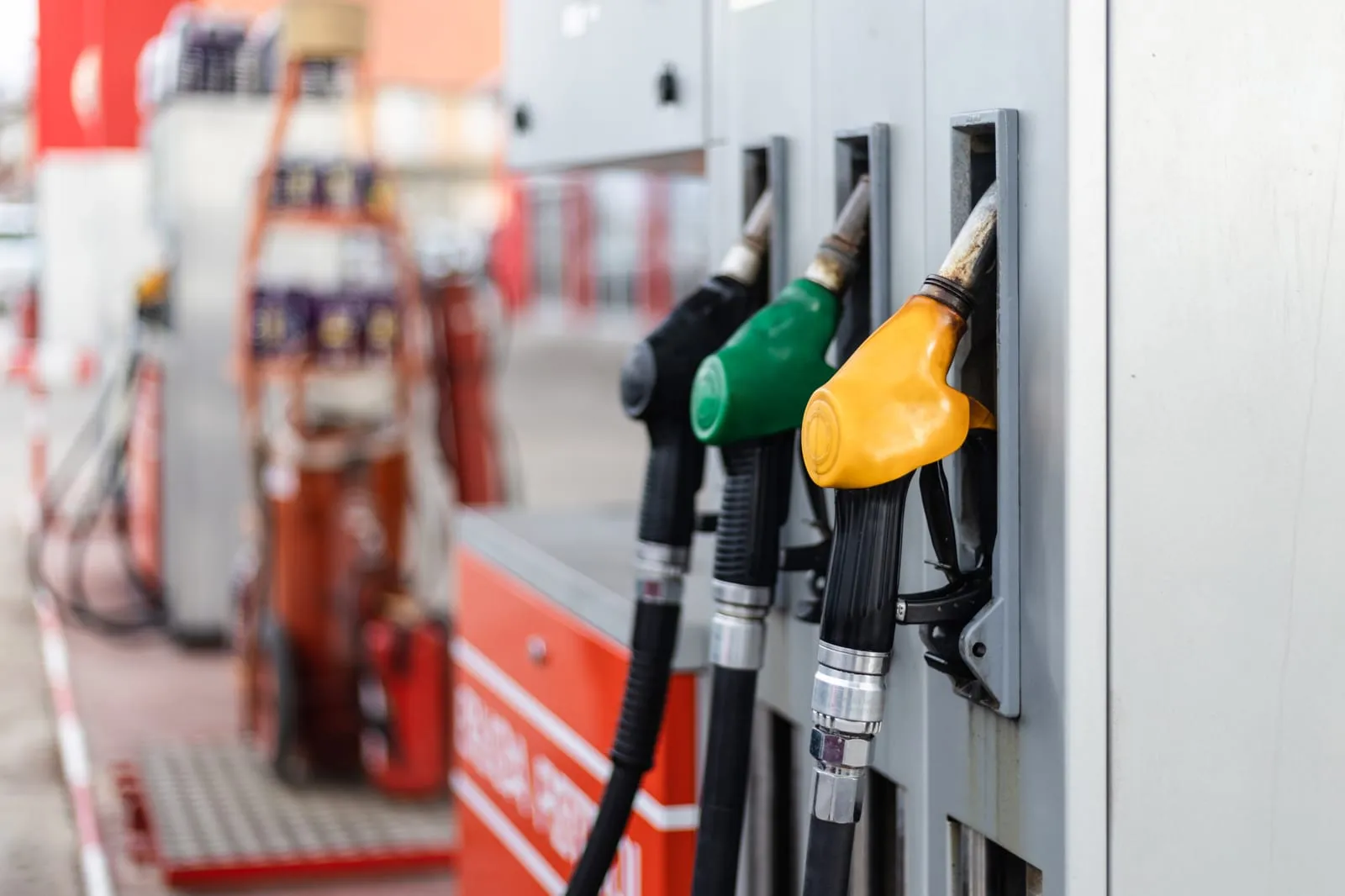
Three fuel pump nozzles hanging on a dispenser at a truck stop

Fuel Optimizer

What's Inside the Optimizer

Four things that turn a fuel card into a fuel plan.

  • Route-aware fuel optimization

    Fuel stops chosen along the whole route, not the next exit — from each vehicle’s tank level, tank capacity, MPG and your negotiated prices.

    How it works
  • Fuel price movement alerts

    Next-day price alerts tell drivers when to fuel before prices along their route change.

    Price alerts
  • Driver compliance tracking

    Every trip is scored on fulfillment and discipline: did the driver take on the gallons the plan asked for, at the stop it named?

    Compliance scoring
  • Planned vs. actual route visibility

    Planned stops beside the truck’s own pings on one map, with out-of-route miles and what they cost.

    Automatic routes

How it works

Where to Fuel, How Much to Fuel, Decided for You

Fueling Performance comes with a true fuel optimizer that generates optimal fuel stops on every route based on each vehicle's tank levels, tank capacity, miles per gallon, and your actual discounted prices.

Drivers get clear guidance on where to fuel and how much to fuel, delivered directly to the communication devices they already use.

3 simple steps

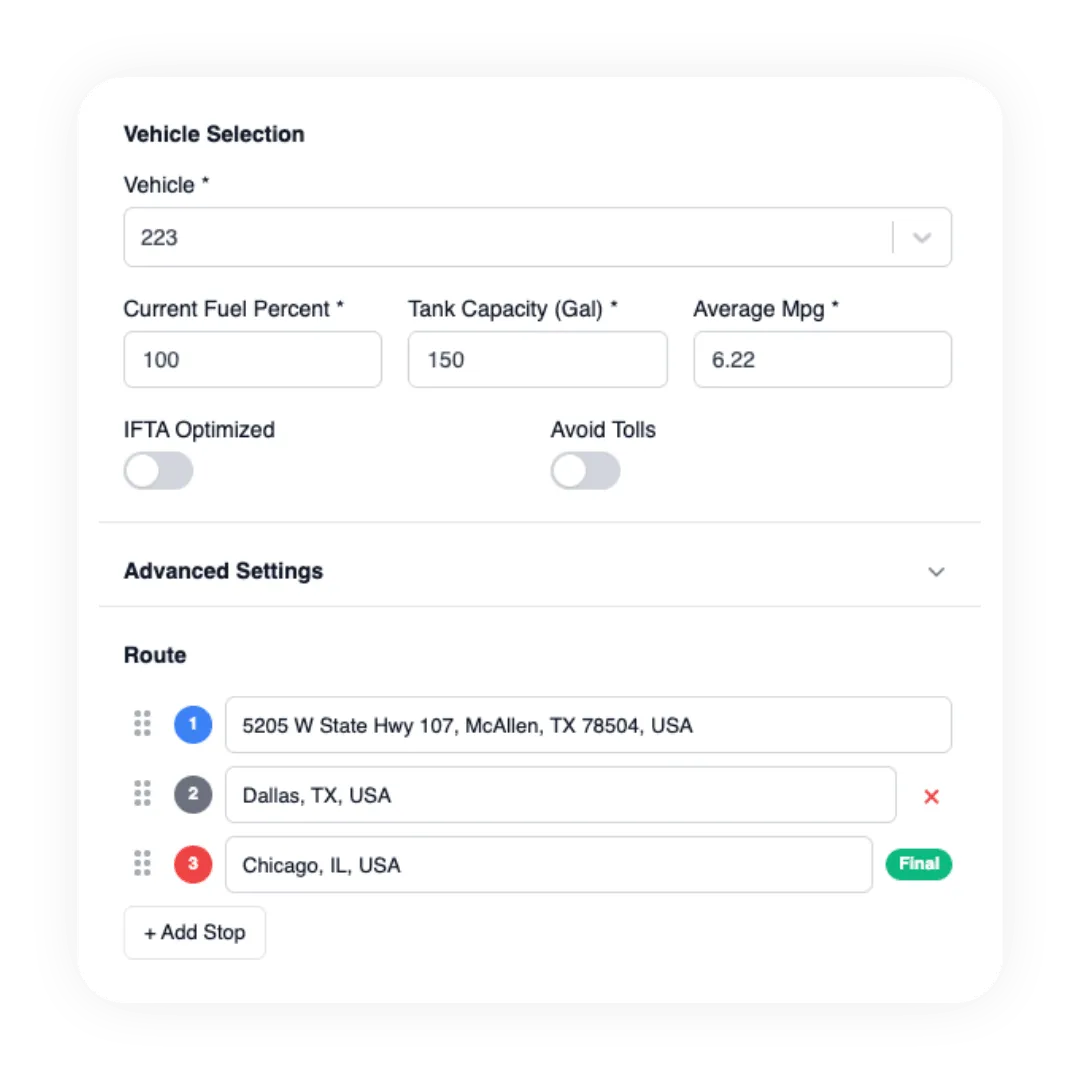
  1. Fuel optimizer form selecting vehicle 223 with tank level, capacity, MPG and a McAllen to Chicago route

    Step 1: Select a vehicle and destination

    Pick the truck; current fuel, tank capacity and MPG come with it. Add the stops, IFTA and toll preferences, and any preferred vendors.

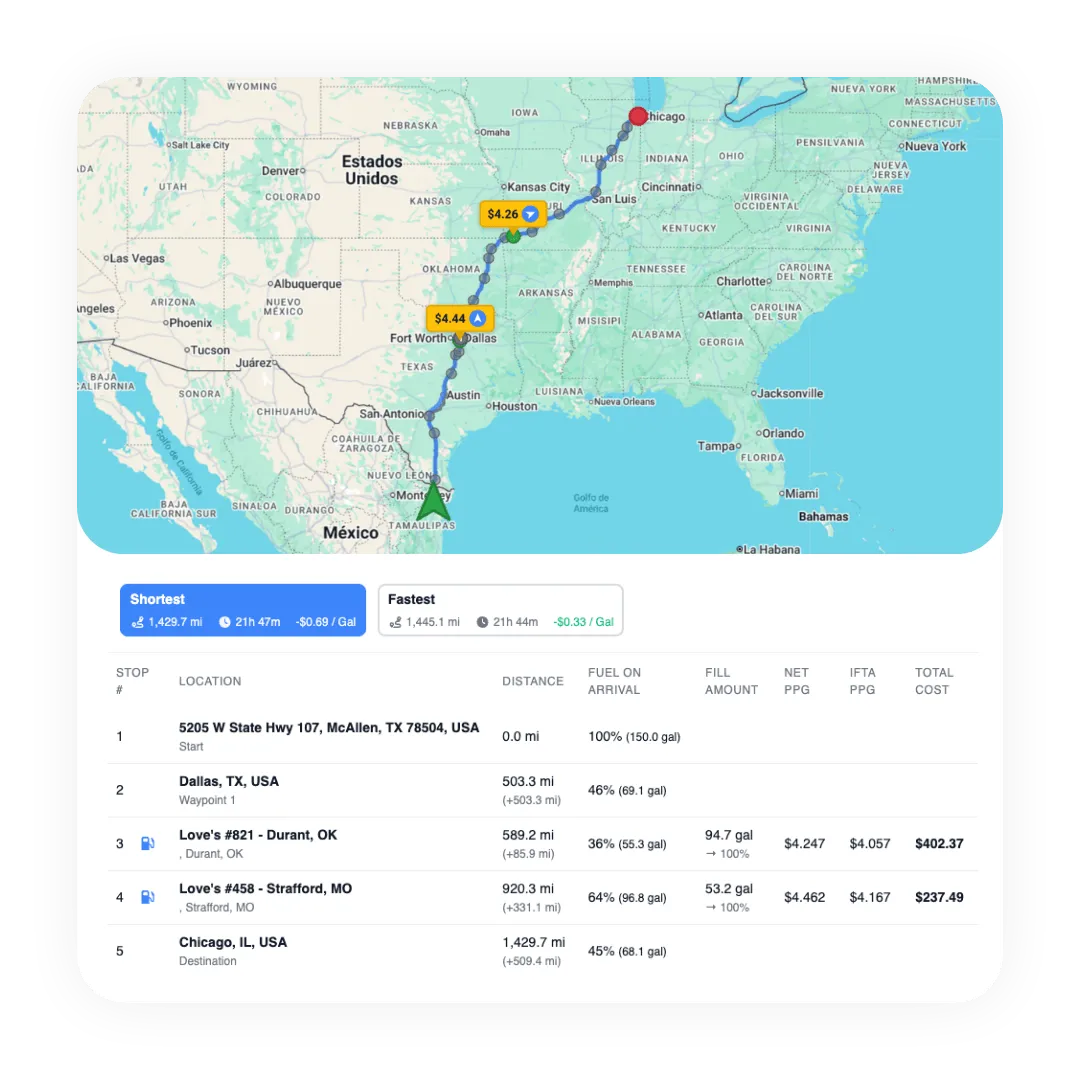
  2. Route map with two recommended fuel stops and a stop-by-stop fuel plan table

    Step 2: Route with predicted fuel opportunities

    The optimizer overlays your negotiated pricing along the route and picks the stations and gallons that cost the least.

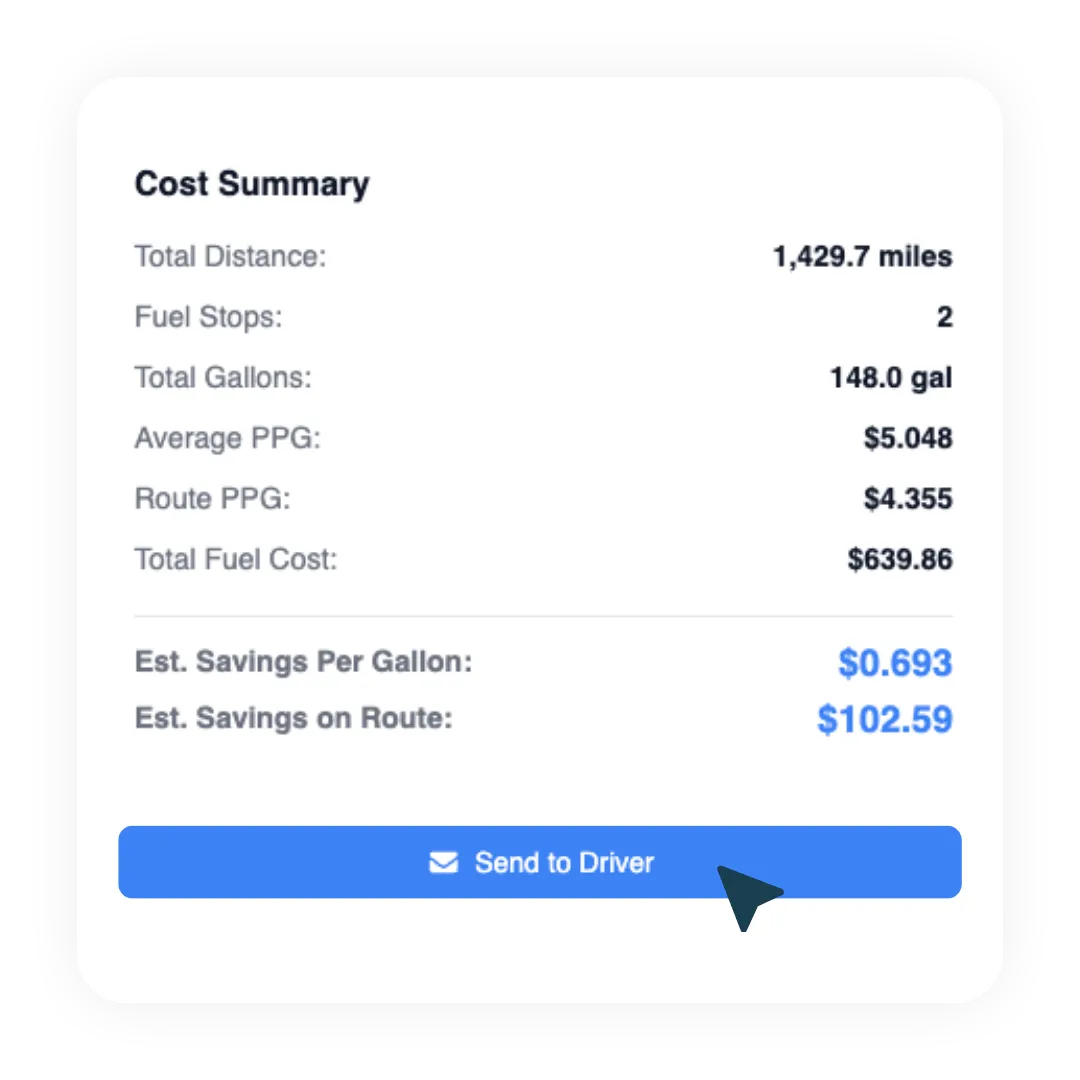
  3. Fuel plan cost summary showing $0.693 per gallon and $102.59 saved on the route, with a Send to Driver button

    Step 3: Send fuel plan to the driver

    One tap sends where to fuel and how much to the driver’s ELD tablet, Telegram or SMS, with the savings on the route.

Stay ahead of price swings

Next-Day Price Alerts, Delivered Directly to Drivers

Fuel prices move every day. Fueling Performance tracks those movements and tells drivers exactly when to fuel before prices change.

Guidance is based on expected market movements and your negotiated pricing, so when there's a better day to buy, drivers know when and where to fuel, on the devices they already carry.

Tablet showing a next-day fuel price alert sent to a driver: Hi Arnold, please try to fuel tonight before 12AM as prices will go up 8 cents along your route.

Automatic route optimization

Routes that plan themselves

Dispatch already knows where every truck is going. Fueling Performance turns each load into a fuel plan on its own — built from the live tank level, sent to the driver, and scored after the trip — without anyone opening the optimizer.

Routes arrive from dispatch

Samsara and Motive routes, Alvys and DataTruck loads, polled every five minutes, or any TMS pushing routes through the public API. Dispatchers can also create a route by hand: vehicle, current fuel, tank capacity, MPG, IFTA-optimized, avoid tolls, preferred vendors, advanced settings and stops.

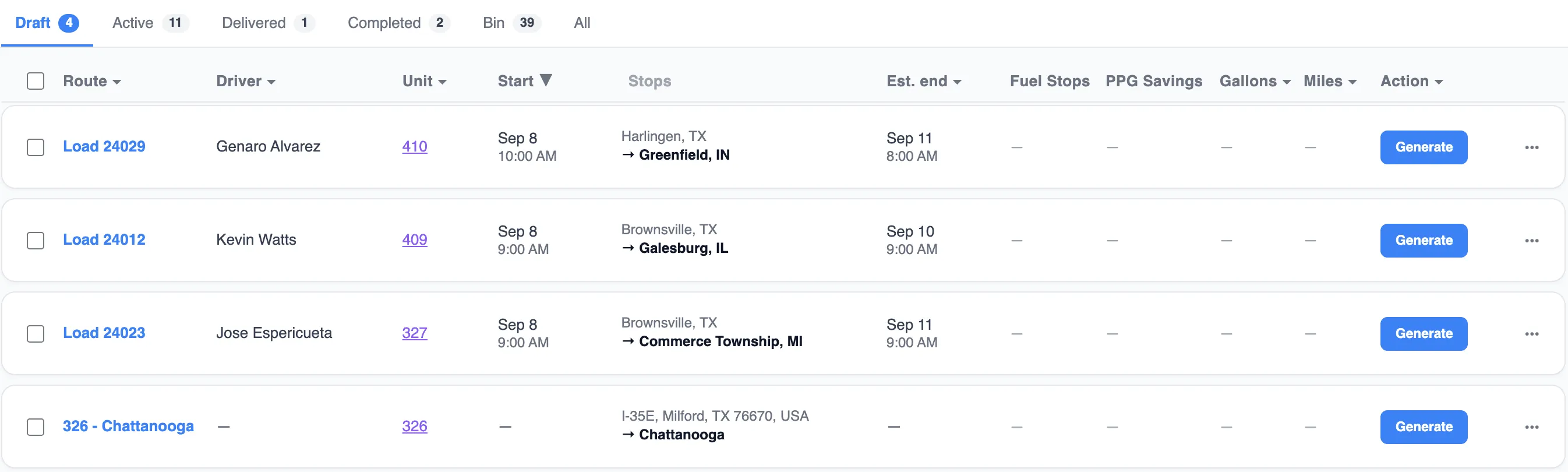
Draft routes tab listing four dispatched loads with driver, unit, start, stops and a Generate button
Loads synced from dispatch, waiting for their fuel plan.

Dispatch sources

Routes and loads, polled every five minutes

The fuel plan builds itself when the truck reaches its first stop

Which stations, how many gallons, at what negotiated price, worked out from the vehicle's live tank level, capacity and MPG. Alternative routes are scored, and the plan shows price-per-gallon savings against the route's reference price and the total saved.

Then it goes to the driver on the channel they already use.

  • ELD tablet message
  • Telegram
  • SMS
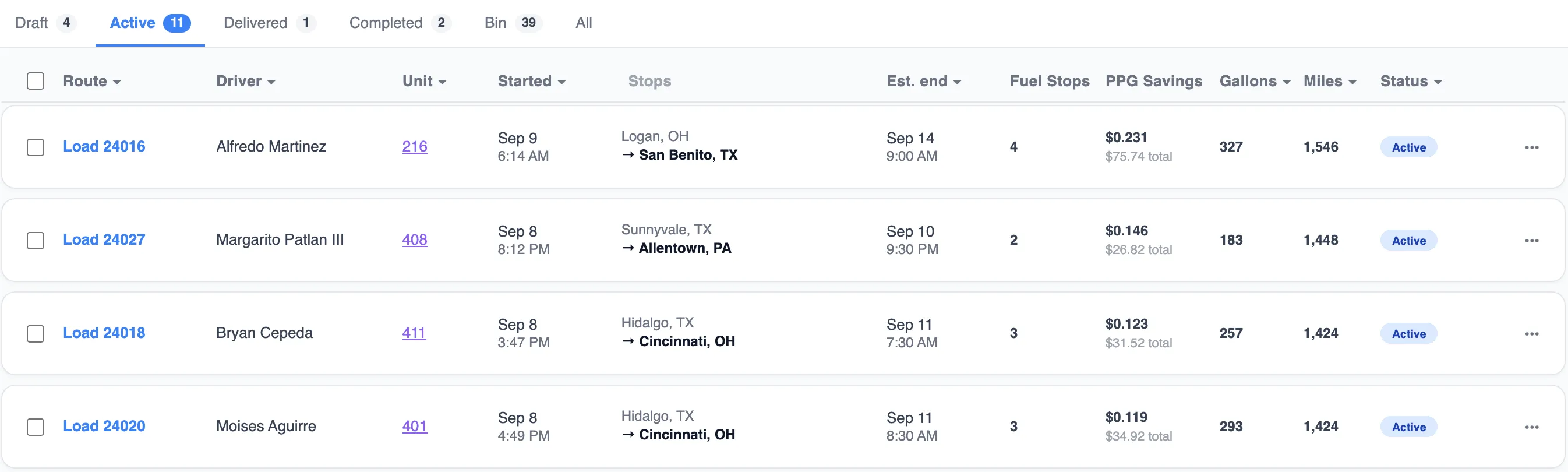
Active routes with generated fuel plans: Load 24016 with 4 fuel stops saving $0.231 per gallon ($75.74 total), plus three more loads with their fuel stops, gallons and miles
Eleven active routes planned automatically: 31 fuel stops, $0.174 per gallon saved, $485 in total.

Drivers get their own page on their phone

No app to install and nothing to type twice: a text or e-mail link signs the driver in, and the page does the rest.

  • The vehicle is pre-selected from the link
  • Fetch from truck pulls current fuel, MPG and location
  • One tap optimizes the route
  • Prices are hidden or shown per your fleet's setting

After the trip

Compliance scoring, by fleet and by driver

Every completed route is scored: stop compliance (planned stops fueled on plan), price per gallon versus plan, out-of-route miles and what they cost, fuel-plan savings and the total cost impact, with the worst offenders first.

Fulfillment
Whether the driver loaded the recommended amount of fuel.
Discipline
Whether they stopped at the recommended location.

The overall score combines both to give you a clear view of fueling compliance.

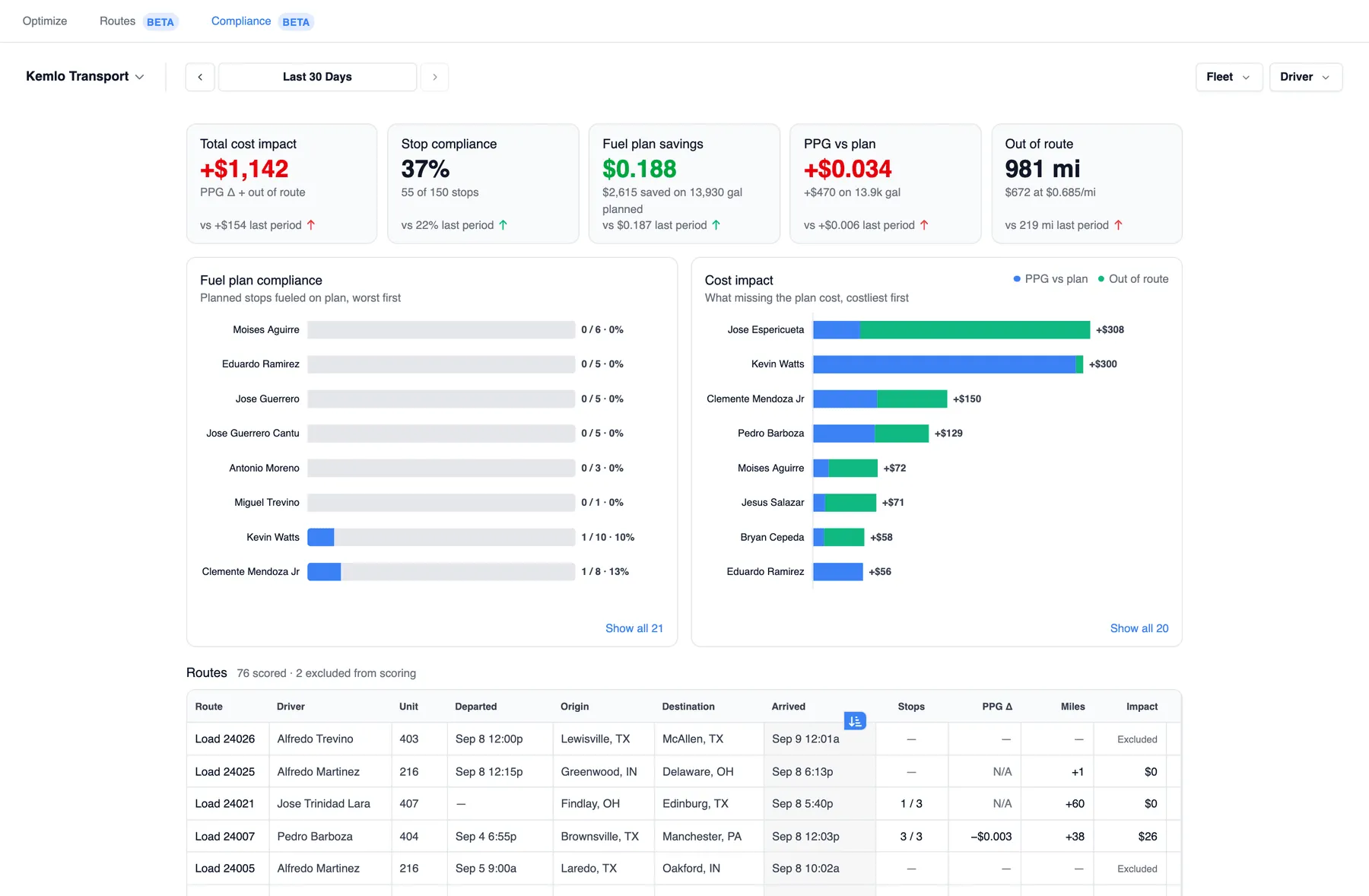
Fuel plan compliance dashboard for the last 30 days: total cost impact +$1,142, stop compliance 37% (55 of 150 stops), fuel plan savings $0.188 per gallon, PPG vs plan +$0.034, 981 out-of-route miles, and per-driver bars for planned stops fueled on plan and for the cost of missing the plan
Stop compliance, fuel-plan savings, PPG vs plan and out-of-route miles, then the drivers who cost the most, first.

Driver Coach

A missed plan becomes a question, not a reprimand

A Driver Coach task, Following the plan, reads the scored routes and drafts the note for you: the evidence it used, the caveats to check first, and the exact text the driver would read. Nothing goes out until you approve it.

Driver Coach70% sureHeld

Alfredo Trevino hit 4 of 9 planned fuel stops but ran 111 miles under plan — draft asks why, not a correction

  • 4 of 9 planned stops hit over 14 Aug–10 Sep, with $12.59 paid above plan and 698 of 771 planned gallons bought.
  • Sep 2 stops: Saundersville, MS and Loudon, TN were both off plan on the same day, about 19¢/gal over.
  • Miles vs plan: 111 miles fewer than plan across 4 routes, so no detour penalty.
Before you act
  • One completed route could not be scored at all, so compliance may look worse or better than 4 of 9.
  • If dispatch confirms the plan stops were reachable within his hours, this becomes a coaching case rather than a planning fix.
What the driver would read

Alfredo — a question, not a ding. On 2 Sep you fuelled at Saundersville, MS and Loudon, TN instead of the planned stops. Across the last four weeks you hit 4 of 9 planned stops. What made the planned ones not work: hours, a dock hold, a site down, or the lane changing? Tell me which stops keep missing and I’ll take it to planning.

Plan complianceOff plan stopsCoaching history

Public API

Push routes from your TMS

REST and JSON, path-versioned /v1, bearer API keys with routes:write, routes:read, vehicles:read and drivers:read scopes. Push a dispatch route, read back the fuel plan with stops, gallons, prices and ETAs. 600 requests per minute per key; sandbox nvl_test_… keys; an OpenAPI contract at /v1/openapi.json.

# illustrative; the docs are the contract

POST /v1/routes
Authorization: Bearer nvl_live_…

{
  "externalId": "load-24016",
  "vehicle": { "unitNumber": "216" },
  "driver": { "name": "Alfredo Martinez" },
  "stops": [
    { "address": "Logan, OH",
      "plannedAt": "2026-09-09T06:00:00-05:00" },
    { "address": "San Benito, TX",
      "plannedAt": "2026-09-14T09:00:00-05:00" }
  ]
}

Next step

Start Buying Smarter, Stop by Stop

Walk through your fleet data and identify where cost, loss, and efficiency can improve. Use our Calendly scheduler to pick a time that works for you.